
People stood at their places with their phone cameras open but faced trouble capturing aircraft formations due to the layer of fog and smoke cloaking the capital.

The country saw 645 events of heavy rainfall and 168 events of very heavy rainfall in November, the highest in the month in five years, the India meteorological department said on Wednesday.

Delhi's air quality deteriorated significantly on Monday, with areas like Dwarka, Mundka and Najafgarh recording an AQI of 500, the worst this season. The city's overall AQI reached 491, triggering the implementation of the Graded Response Action Plan (GRAP) Stage-IV restrictions in Delhi-NCR. Doctors warned of health risks, urging people to wear N95 masks and avoid outdoor activities. The Supreme Court questioned the Delhi government on its anti-pollution measures and warned against scaling down preventive measures without its permission. Delhi Chief Minister Atishi accused the BJP-led central government of political maneuvering while neglecting stubble burning in states it governs. Meanwhile, the city enforced stricter pollution control measures, including a ban on truck entry and suspension of construction activities. Air purifier sales surged, reflecting the public's concern over the severe air pollution.

The state broadcasters have started the practice, but private news channels may follow suit, a ministry source said.
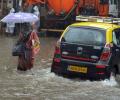
The rest of Maharashtra was very likely to get rain and thundershowers in isolated places during this period, the official informed.

Severe cyclonic storm Tauktae that is hovering over Saurashtra in Gujarat would move north-northeastwards and weaken gradually into a cyclonic storm during next three hours, informed the India Meteorological Department (IMD).

The India Meteorological Department (IMD) seems to have taken a cautious stand over the World Meteorological Organisation's (WMO) projection of a 'poor monsoon' due to a probable 'El Nino' impact. The IMD did not agree with WMO's projections, saying, "El Nino and the progress of monsoon are not mutually exclusive events", and remained non-committal over its earlier projection of a "normal monsoon" for the June-September 2009 season.

Odisha is bracing for heavy rainfall early next week under the impact of a possible cyclone in the Bay of Bengal, which is likely to skirt the state and move towards West Bengal and Bangladesh, the Indian Meteorological Department (IMD) said on Friday.
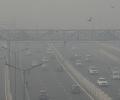
Delhi's 24-hour average air quality index (AQI) stood at 248 on Saturday.

Mumbai has received 253.3 mm rainfall in the 24 hours ending 8 am on Friday.

Authorities in Tamil Nadu and Puducherry have taken a slew of measures to handle the situation arising out of the cyclonic storm, which has led to heavy rainfall in several regions.

At the review meeting, chaired by cabinet secretary Rajiv Gauba in New Delhi, the IMD said above normal maximum temperatures are likely over most parts of northeast, east and central India and some parts of northwest India.

The January of 1919 recorded 15 degree Celsius and it remains the warmest January so far. "So January 2021 has also become the warmest in 62 years after 1958," the IMD said.

The government on Wednesday raised the minimum support price (MSP) for paddy by 5.35 per cent to Rs 2,300 per quintal for the 2024-25 kharif marketing season. The hike in paddy support price comes despite the government sitting on surplus rice stocks, but it is significant ahead of elections in states like Haryana, Maharashtra, Jharkhand, and Delhi.

Brace for some warmth this winter as the India Meteorological Department (IMD) in its December-February forecast on Thursday said that the minimum and maximum temperatures could remain 'normal' to 'above normal' over most parts of Northwest and Northeast India. Both the minimum and maximum will remain below normal in Southern Peninsular and Central India in these winter months. While this could give some respite from the intense cold of North India, it could have a negative impact on the standing rabi crops if the temperature rise is unusual and abnormal.
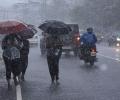
Two persons, including an eight-year-old child, died after being swept away in a flash flood at Mankayam waterfalls in Palode near Thiruvananthapuram, police said on Monday.

The weather department attributed the unusual heat to the lack of rainfall due to the absence of active western disturbances over north India and any major system over south India.

Expected to be over 100% of long average period.
After remaining stationary for several hours over the sea, the cyclonic storm 'Phailin' on Thursday intensified, moving slightly northwest and lay centered at about 850 km southeast of Paradip.

As per the India Meteorological Department (IMD), which closely monitors the cyclonic storm said, 'The SCS 'Mocha' intensified into a very severe cyclonic storm, lay centred at 05.30 hours IST of 12th May 2023 over central adjoining southeast Bay of Bengal near latitude 13.2N and long 88.1E, about 520 km west-northwest of Port Blair.'

The same development would benefit the progress of the north-east monsoon, also known as the 'reverse monsoon'.
A mild intensity earthquake with a magnitude of 3.2 on the Richter scale stuck the Koyna dam region in Satara on Monday night, officials said.

The Mumbai civic body and police have advised all people in the city and surrounding areas to stay indoors as much as possible.

The flood-hit religious destinations of Kedarnath, Badrinath, Yamunotri and Gangotri, where rescue operations are underway, would again record heavy rains from Thursday, the India Meteorological Department said on Friday. It also predicted "rather heavy showers" in Hemkund Sahib, another religious destination hit by flash floods and heavy rains, from Wednesday.

Any long dry spell could cause moisture stress in the standing crop during the crucial maturing stage and also make it prone to pest and disease attacks.
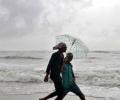
Southwest monsoon has furthered advanced into some parts of south Arabian Sea

The searing heat pushed the city's peak power demand to its highest for May, while the Delhi government directed the schools that have not closed for summer vacations to do so with immediate effect.

Delhi recorded its second hottest April this year since 1951 with a monthly average maximum temperature of 40.2 degrees Celsius.

The India meteorological department (IMD) on Wednesday evening issued a red alert for Mumbai and its neighbouring districts, predicting "extremely heavy rainfall".
The sluggish southwest monsoon, which yielded one of the driest Junes in a century this year, appears disappointing this month as well.
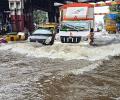
Flight services at Mumbai airport were severely impacted on Monday due to low visibility after heavy rains in the city, leading to runway operations being shut for over an hour and approximately 50 flights being cancelled, sources said.

The India Meteorological Department has issued a 'Red Alert' and predicted 'very heavy' to 'extremely heavy' rainfall across several districts of Assam till Thursday.
All parts except Northeast may get below-normal rain; govt reiterates assurance on preparations.

Airfares on major domestic routes from Chennai surged as flight operations at the airport were disrupted due to strong winds and torrential rain that lashed the city in the wake of Cyclone Michaung on Monday. According to ixigo data, on December 5, one-way spot airfares from Chennai to cities like Mumbai, New Delhi, Hyderabad, Bengaluru, and Kolkata rose between 52 per cent and 171 per cent compared to prices three to seven days prior. The Chennai-Mumbai route, the busiest flight route from Chennai airport, saw airfares surge 68.6 per cent from Rs 3,728 to Rs 6,286 in the aforementioned period.
With El Nino emerging, forecasts rainfall at 95% of long-period average.
Market for localised weather forecasting in India offers immense scope; credibility of data a concern.

The Safdarjung Observatory, which provides representative data for the city, recorded a maximum temperature of 40.1 degrees Celsius, which was eight notches more than normal, said Kuldeep Srivastava, the head of the IMD's regional forecasting centre.

Very heavy rainfall is likely to occur at one or two places in Kerala on Wednesday.

India's crucial monsoon will be normal this year but with less heavier rains as the weather office on Friday marginally downgraded its earlier forecast.

Operations at the Delhi airport remained normal. However, three flights were returned or diverted to the Delhi airport due to bad weather in Chandigarh, Varanasi and Lucknow on Tuesday night.
